

AI-powered tool helps predict cancer risk in Barrett's esophagus


PHILADELPHIA (WPVI) -- Many people struggle with chronic acid reflux - or GERD. The big worry is that it will develop into Barrett's esophagus, and then esophageal cancer.
But figuring out who might get cancer just got easier with a new AI-driven tool.
Elizabeth Kirwin loved ethnic food, until GERD made mealtime miserable.
"No Mexican food, no Indian food," Elizabeth recalls. "Anything spicy, anything. Things with red sauce."
The reflux also kept her up at night.
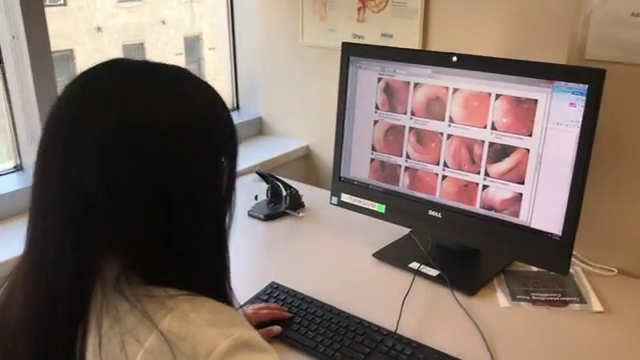
When doctors put a tiny camera into Elizabeth's digestive tract, they found Barrett's esophagus.
"It creates like a whole new sort of interior layer in your esophagus," she explains.
"About 5 to 12% of those with chronic GERD will develop Barrett's esophagus," said Dr. Neena Mohan, a Temple Health gastroenterologist. "Barrett's itself is a precancerous lesion. So it requires monitoring and potentially treatment."
But Dr. Mohan says the challenge is identifying who might get cancer.
It's been based on the length of the Barrett's segment and frequent biopsies looking for abnormal cells. Now, she has high-tech help.
"A risk stratification tool that uses multiple biomarkers and AI to be able to give us a prediction of who is at high risk for progressing," she says.
High risk patients might need tests every six to 12 months, or more frequent treatments.
"Radiofrequency ablation, cryoablation, hybrid argon plasma coagulations," Dr. Mohan notes.
Low-risk ones might only need tests every three to five years.
Similar AI tools are used to tell breast cancer patients who needs chemotherapy.
"I came back in the lowest group, which, you know, is like less than 3 or 4% chance of getting cancer," Elizabeth says.
After a year of medication and surgery for a hiatal hernia, she is eating what she loves again.
"I can eat Mexican food. I can have pizza. I can have Italian food," she says. "It's wonderful to not be afraid of food again."
Dr. Mohan says the more information patients get about their disease, the better they are at following treatment.
She says Temple Health is one of the few centers in the area to offer TissueCypher.