

Cataract surgery reduces or eliminates need for glasses


PHILADELPHIA (WPVI) -- Some people notice blurry vision.
Others see annoying starbursts or halos around lights at night.
Still others have double vision.
All are experiencing cataracts, one of the most common medical problems.
Juanita Jacobs of North Philadelphia always took care of her vision because of a detail-oriented job and family history.
"I have glaucoma because it runs in my family," Juanita explains.
But in recent years, she was frustrated at needing glasses more and more.
"I have to always have my glasses on to see the normal things that people see," she says.
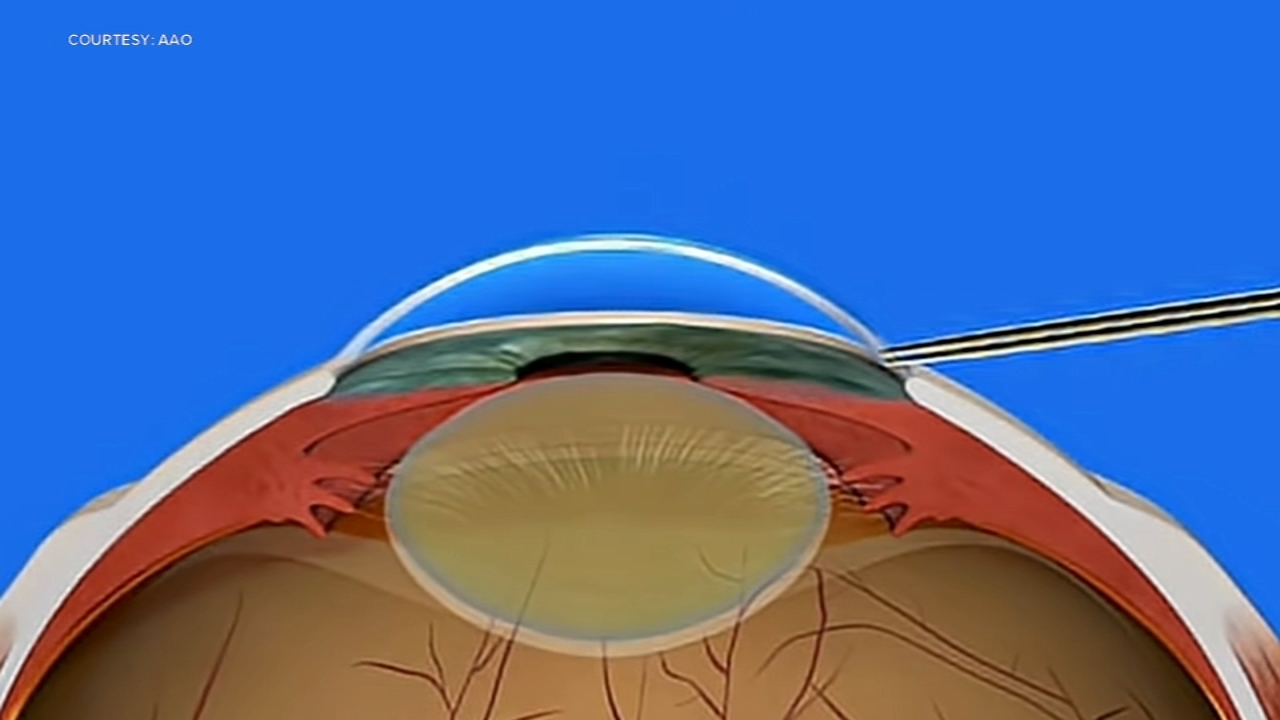
Dr Jeff Henderer, Juanita's Temple Health ophthalmologist, says she'd also developed cataracts - clouding of the natural lens.
"By virtue of living long enough, you will get a cataract," Dr. Henderer notes.
"It typically turns a color more like a greenish-yellow kind of color, kind of a brownish color at the end stage," he says.
Changes usually take years, but can cause blurry vision, needing brighter light for reading, halos or starbursts around lights at night, or frequent changes in eyeglass or contact lens prescriptions.
Some people develop double vision or ghost images with their cataracts.
When the cataract affects daily life, Dr. Henderer says it's time for surgery to replace the bad lens.
After the eye is numbed, a tiny incision is made at the edge of the cornea.
Very small instruments will break up and remove the clouded lens, then put in an artificial lens.
The lens goes in rolled up, then it's opened up.
Anchors hold it in place permanently.
"The surgery typically takes 15 minutes or less. It's done using local anesthesia," he says, meaning patients are awake.
Patients go home right away, with no yellowed lens to block light, especially blue colors.
"All of a sudden, they're like - wow - the world is a lot more blue and a lot brighter," is a comment Dr. Henderer hears time and again.
Eye drops are essential afterward to prevent infection and bring down swelling.
Eyes are operated on one at a time, with a few weeks or more between the operations.
Juanita's right eye was done last year, her left eye in May.
With both eyes now done, Juanita is enjoying her new vision.
"I went to the art museum with my sister about a month ago and I was able to see things better there," she says.
Standard lenses are set for 1 distance, so most people still need glasses for reading or computer work.
But 6 months afterward, 90 to 95% of people are satisfied with their results.