

EOE: First spotted in kids, it's now adult problem, too | Moves in Medicine


PHILADELPHIA (WPVI) -- Imagine taking a bite of a meal, but not being able to swallow it, or feeling it get stuck. It could be an unusual allergic reaction called eosinophilic esophagitis, or EOE for short.
About five years ago, during a routine meal, Joe Schweizer started choking.
"My wife had to give me the Heimlich maneuver," Joe remembers vividly.
A similar incident happened months later.
"I'd swallow and then I would just feel something get caught," he explains. "I literally would feel it move down and eventually like release."
Joe's quest for answers led to Temple Health gastroenterologist Dr. Mark Malamood, who suspected eosinophilic esophagitis, better known as EOE.
"It is an inflammatory condition in the esophagus involving a type of naturally occurring white blood cell called eosinophils," Dr Malamood says.
Eosinophils are essential to the immune system, but when a trigger - like a virus, bacteria, food, or environmental factor - sparks a buildup in the esophagus, the cells cause damages to the lining.
Food is hard to swallow, or gets stuck. It made Joe miserable.
"Eating became a chore. It wasn't something that was enjoyable anymore," he says.
"There's pretty compelling evidence that a lot of EOE is caused by food allergies or food intolerances," says Dr. Malamood.
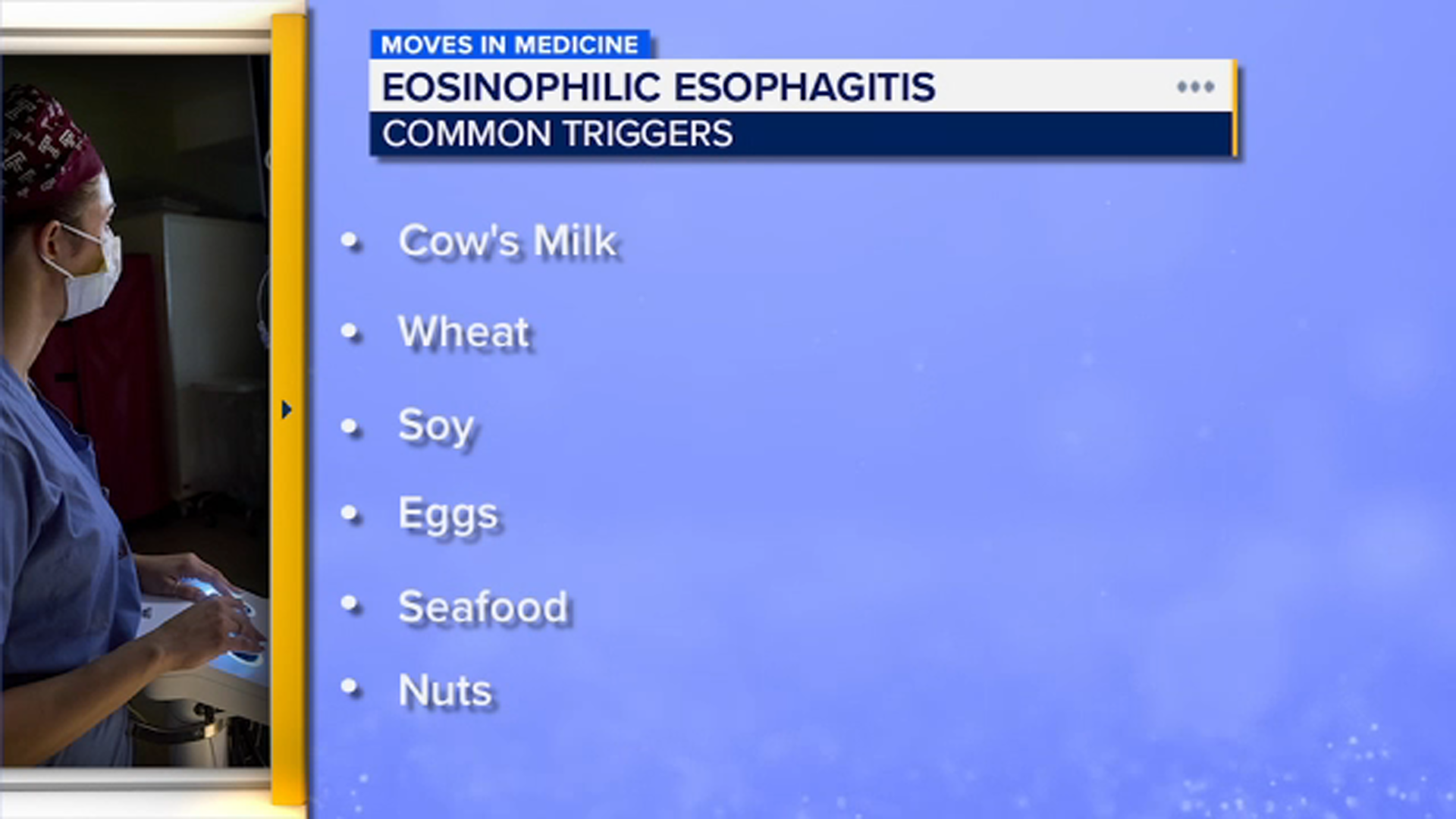
The two most common food triggers are cow's milk and wheat, though soy, eggs, seafood and nuts can also be culprits.
However, food tolerance tests can't always find the cause.
"And food triggers are not the entire picture. There's also likely issues in the esophagus itself involving sort of our inflammatory cascade," the doctor says.
Joe was fortunate that the FDA had just approved Dupixent for EOE. Dupixent is a monoclonal antibody which blocks the immune overreaction.
"From my personal experience, it really has been thus far a pretty big game changer," Dr. Malamood notes. "Every single patient I put it on, besides one, has had a full response at their first follow-up endoscopy. We gave it a few more months and she had a whole response."
The inflammation in Joe's esophagus has gone down, and he and his wife are again enjoying the city's food scene.
"We like Italian, Vietnamese, Chinese, American..." Joe says.
Shortly after Joe was diagnosed with EOE, his father was also diagnosed.
"It's a disease that we're learning more about every year. There is apparently some genetic predisposition to it. It can run together in families," Dr. Malamood says.
In extreme cases, or left untreated, EOE can lead to stricture or stiffening of the esophagus, requiring stretching procedures to open up.
When EOE was first identified 30 years ago, it was just among kids.
But Dr. Malamood says it's exploded among adults across the board - more than increased awareness can explain.
He believes the rise is due to something in the environment or affecting our immune system.