

Fast recognition is key to surviving aortic dissection


NORTHEAST PHILADELPHIA (WPVI) -- The power of knowing your family history. It plays a role in so many conditions, even if the genetics aren't known yet.
And a son's quick recall of his family may have saved his mother's life.
Michele McNamee has always been a runner - proud of being a regular in the Broad Street Run.
Four years ago, the day after a 5-mile run, she woke up in pain.
"I had jaw pain, thought I was having a heart attack," Michele recalls.
But it got worse.
"The shortness of breath, that's what scared me more than the jaw pain," she adds.
At the hospital, doctors told her son it was likely a heart attack, until: "He told the doctors that my mom a couple years ago had an aortic dissection. So they took me into CAT scan and they said, sure enough, that's what I was having," Michele explains.
Dr. Suyog Mokashi, a Temple Health cardiovascular surgeon, says something disrupts the three layers of the aorta, the body's main artery.
"You're getting a breach of the layers, usually the breach between the first and the second layers," Dr. Mokashi says.
Instead of flowing inside the aorta, blood goes between the layers.
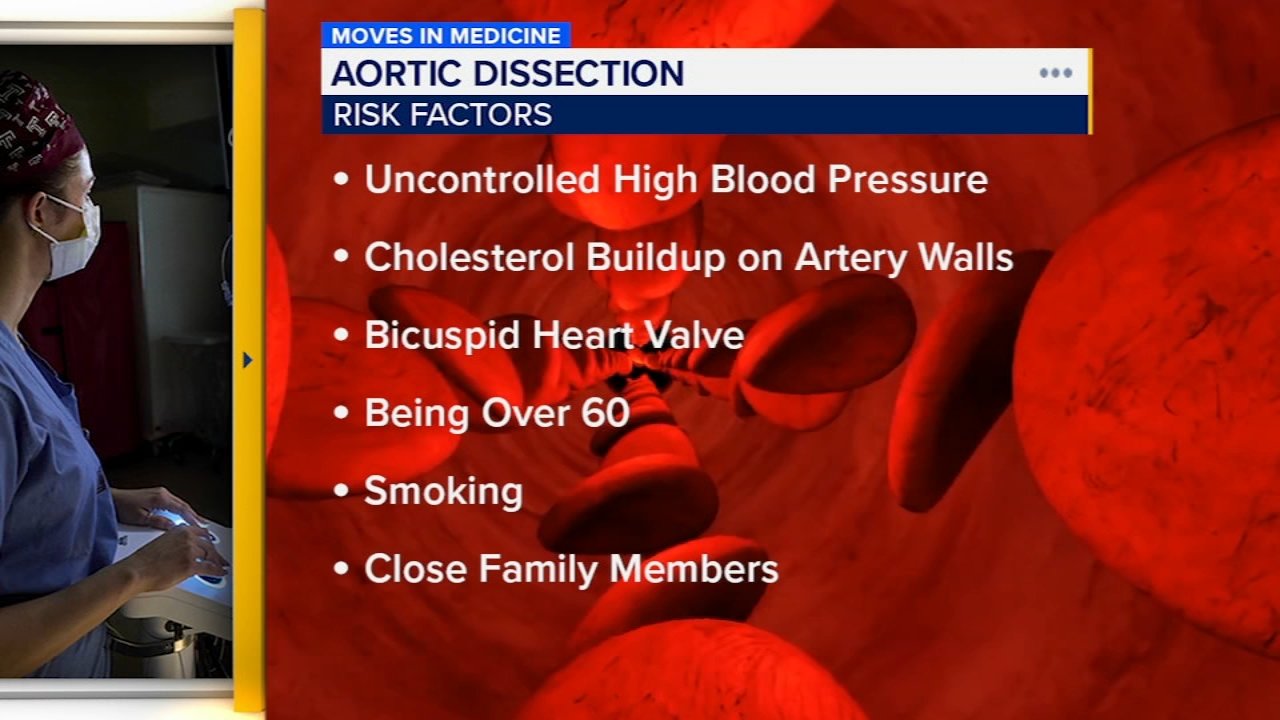
Long-term high blood pressure is the biggest risk factor, but there are others - cholesterol buildup on artery walls, a heart valve defect called a bicuspid valve, being over 60 years old, smoking, and having close family members with it.
"Is there anyone in your family who had a history of sudden death at a young age - in a non-trauma?" he asks aortic dissection patients.
Fast recognition and emergency surgery are key to survival.
"Without surgery in the first 24 hours, the mortality is greater than 50%," he notes.
Another key is being at a center with specialized aortic surgery and post-operation care.
"They need a lot of close care to keep them stable," explains Bill Moser, NP, an acute-care nurse practitioner.
Moser says recovery is gradual, with regular CT scan monitoring and lifelong limits on heavy lifting.
"That dissection becomes a major portion of their health care for the rest of their lives," he says.
Despite doctors' predictions she'd never run like before, and challenges from the medications she takes, Michele is ready for Broad Street again, and wants one more chance.
If I can do this, I'll do something else. I'll try to do the half-marathon," she says with a smile.
Michele, a physical therapist, has advice from being on the other side of healthcare: Speak up on your symptoms, and if they don't understand a diagnosis, procedure, or medication.
She says she often asks doctors to slow down and simplify their explanations.