How will Supreme Court voting rights ruling shape future redistricting?


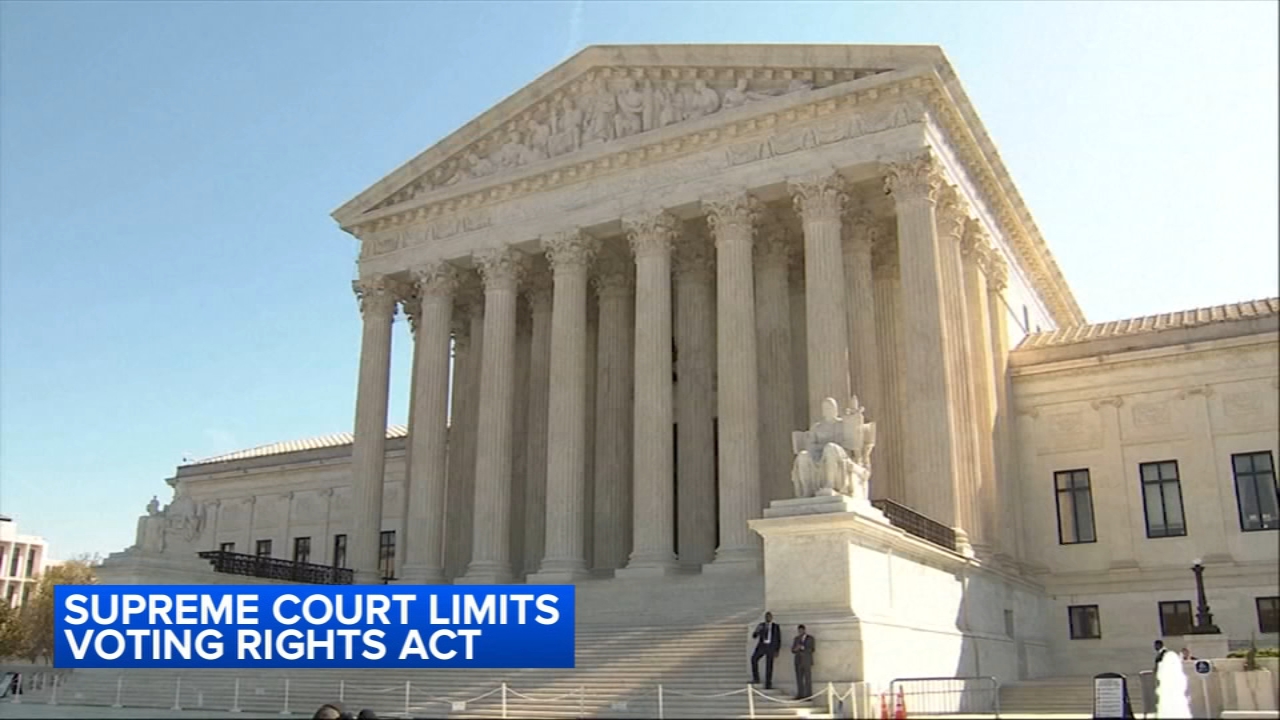
PHILADELPHIA (WPVI) -- A U.S. Supreme Court ruling declaring Louisiana's recent congressional map unconstitutional is not expected to trigger immediate changes to congressional districts in Pennsylvania or New Jersey, but experts say it may have broad implications for voters and future redistricting efforts.
Local voters reacted to the decision, which struck down Louisiana's redrawing of its map to create a second majority Black district.
Barbara A. Simmons, of Francisville, said she hopes the ruling motivates civic engagement.
"What I'm hoping is that it'll cause people to work even harder to get out to vote," Simmons said.
RELATED | Supreme Court voids majority Black congressional district in Louisiana, boosting Republican chances
Rutgers Law School professor Stacy Hawkins said she was not surprised by the court's 6-3 decision and pointed to the court's earlier actions involving the Voting Rights Act.
"I think the Supreme Court foreshadowed this going all the way back to 2013 when they gutted the first provision of the Voting Rights Act," Hawkins said.
The ruling centers on Section 2 of the Voting Rights Act of 1965, which prohibits voting practices or procedures that discriminate on the basis of race. Civil rights groups, including the NAACP, are calling the decision a devastating blow to voting rights.
Lauren Cristella, president and CEO of the Committee of Seventy, said Pennsylvania does not plan to revisit its congressional maps until 2031. Still, she said the decision could influence redistricting nationwide.
"Right now it is a very partisan process that will take place in the next cycle," Cristella said. "And it'll all depend on who the chair of that redistricting commission is. We don't know who that will be. We don't know if they'll be fair-minded, and the legislature picks them."
Hawkins also pointed to the potential effects on districts such as Pennsylvania's 3rd Congressional District, where candidates met for a debate on Wednesday ahead of the May primary.
"Certainly, Dwight Evans' seat may owe its representation to being a minority majority district," Hawkins said. "And so I think anyone serving in a minority-majority district certainly has their seat threatened."
The White House praised the ruling, calling it "a complete and total victory for American voters," and said the decision protects voting rights from abuse of the Voting Rights Act.
In Louisiana, where the primary election is about two weeks away, state officials are scrambling to determine how the ruling will affect the upcoming vote.