

Rash that won't go away could be cutaneous lymphoma


PHILADELPHIA (WPVI) -- Skin rashes can be a real nuisance, but they're generally benign. However, there is one time when that incessant itching can be a sign of something more serious.
"This tends to be a very itchy rash," says Dr. Anthony Stack, a hematological oncologist at Fox Chase Cancer Center, referring to cutaneous lymphoma.
Lymphoma is a blood cancer of white cells called lymphocytes.
"Some of these lymphocytes actually reside or live in the skin, and when those skin lymphocytes develop cancer, that's what we call cutaneous lymphoma," Dr. Stack says.
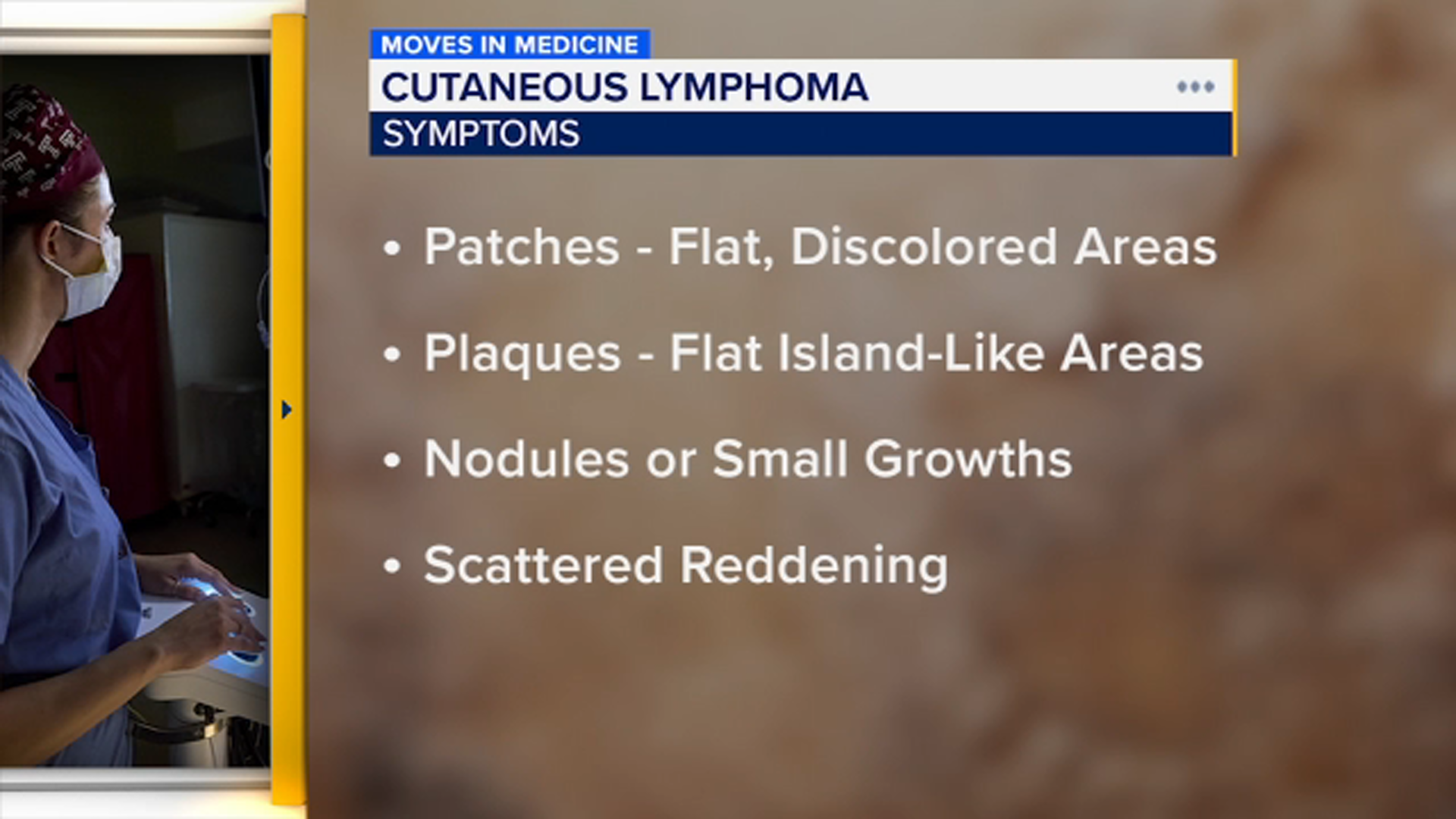
The rash can look different in different people.
There can be patches - flat, stain-like, discolored areas.
"It can be a raised kind of flat-island-like area on the skin, and that's called a plaque, Dr. Stack says.
There can also be nodules or small growths out of the skin, or perhaps a scattered reddening.
Cutaneous lymphoma can also vary by skin tone - pinkish or reddish areas on light skin, and dark or even gray areas on darker skin.
"It can really mimic a lot more common skin conditions like eczema or psoriasis," he notes.
And that can lead to a delay in diagnosis, taking an average of three to four years from first showing to final diagnosis.



Dr. Stack says that, unlike eczema, which often appears on the extremities, cutaneous lymphoma is more common on the thighs, lower abdomen, or back.
Most cases appear between 50 and 70 years of age.
Men are twice as likely as women to develop it, and it's slightly more common among African Americans.
Fortunately, this rare cancer isn't usually aggressive, and treatment is usually limited to the skin.
"These can be things like creams or ointments, light, UV-light therapy actually works quite well for this, or targeted radiation therapy," he explains.
Dr. Stack says that although cutaneous lymphoma is rare, it's worth checking out any persistent rash.
"A rash that's not going away, that's staying in the same place, that's very itchy despite treatments," he emphasizes.
Dr. Stack says research on cutaneous lymphoma lagged for years, but some promising new treatments are now in clinical trials.