

Turning off atrial fibrillation with cardiac ablation


PHILADELPHIA (WPVI) -- Most of us have heard of atrial fibrillation, commonly called AFib.
The airwaves are filled with commercials for treatments.
A Roxborough woman shared her struggle with it, and the procedure that ended her irregular heartbeats.
"I woke up and my heart rate was like 120, which had never happened before," Jeanne Oski vividly remembers of that night nearly 20 years ago.
She was frightened.
My mother died at 69 of heart disease and my grandmother died at 70 of heart disease," Jeanne says.
Staff at the hospital quieted Jeanne's racing heart.
And tests showed that, like her mother and grandmother, she had atrial fibrillation - an irregular heartbeat.
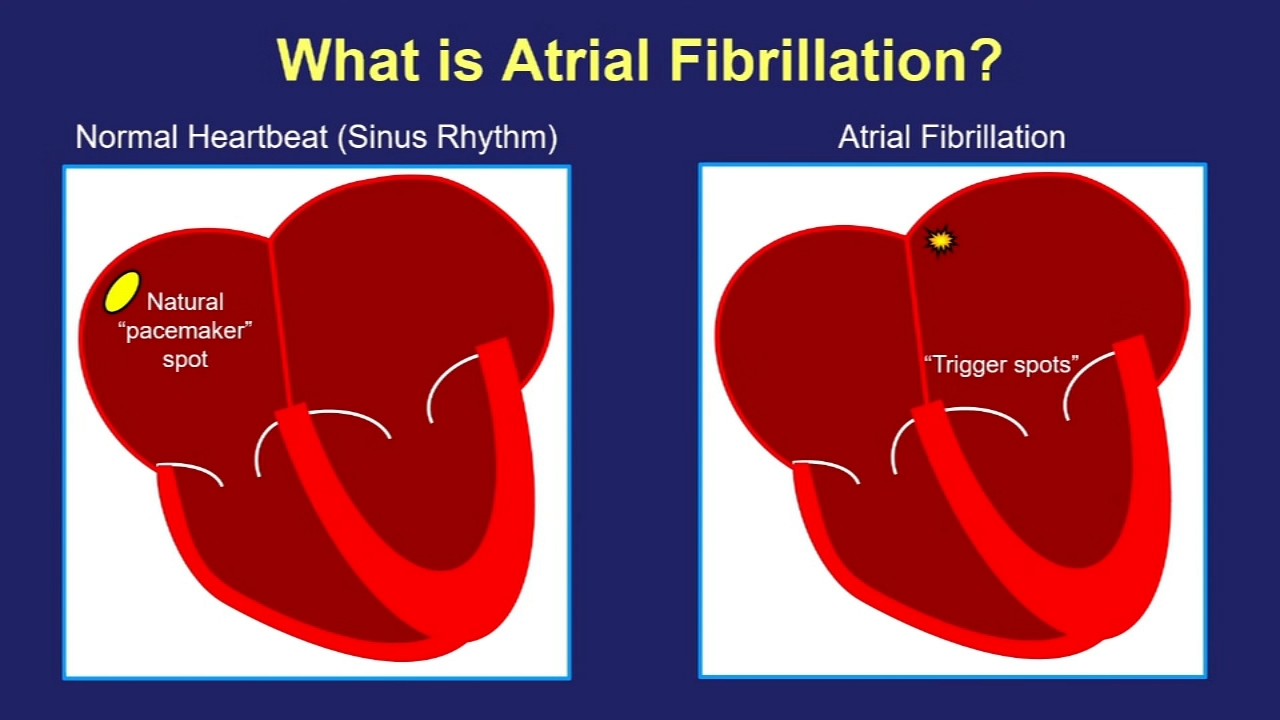
Electrophysiologist Joshua Cooper of Temple Health says AFib is so common, he made a video to explain it.
"Each heartbeat normally, in normal rhythm, starts in the top right part of the heart, in the natural pacemaker spot," the video says, explaining how heartbeats start.
In AFib, tiny scars between heart cells make electrical signals more chaotic.
"So the bottom pumping chambers start to beat fast and irregular," Dr. Cooper says.
The causes include aging, sleep apnea, obesity, diabetes, thyroid problems, and alcohol.
Dr. Cooper says two steps must be done right away: reduce the risk of stroke with a blood thinner and use medication to slow the bridge and slow the heartbeat.


At first, Jeanne had very few episodes.
"I took the medication and it went away," Jeanne says.
Over time, episodes became more frequent and harder to stop, such as on the way to an Eagles game.
"All of a sudden I go into AFib. I'm like, 'You gotta be kidding me'," Jeanne recalls.
Or on vacation.
"I was in Germany, going down the Rhine, and all of a sudden, that morning, I went into AFib," Jeanne says.
She and Dr. Cooper decided it was time for ablation to get rid of the misfiring spots.
With the patient under anesthesia, wires are threaded into the trouble area to eliminate those spots.
"By either placing burns or using little shocks or sometimes even freezing the heart muscle," he says.
About 85% of the time, as in Jeanne's case, one ablation is enough.
"I have not had a symptom since, and I'm off all my medications. I have way more energy," she says happily.
Dr Cooper, who calls himself a "heart electrician," says treatment has to be personalized, because the electrical issues and symptoms vary person-to-person.
To see his video explaining atrial fibrillation, CLICK HERE.