

Weighing the options for treating an enlarged prostate


PHILADELPHIA (WPVI) -- At some point, most men will deal with an enlarged prostate gland and they often struggle to find a solution that works for them.
A urologist at the Fox Chase-Temple Urologic Institute explains the pros and cons of some treatments, and why prostate problems shouldn't be ignored.
"We walked to the stadium, which is roughly a half hour or more away," recalls Kristian Shannon of Quakertown, Pa.
Shannon and a friend were headed to see the Nittany Lions when his prostate problems became obvious.
"I probably stopped at every portajohn along the way," he adds.
When his friend noted that, Shannon knew that what had become normal for him wasn't normal.
Dr. Steve Sterious of Fox Chase-Temple Urologic Institute sees men every day with an enlarged prostate, or BPH.
"If you hit 50, 50% of the population will have it, you know, 60 - 60%, 70 - 70%," Dr. Sterious notes.
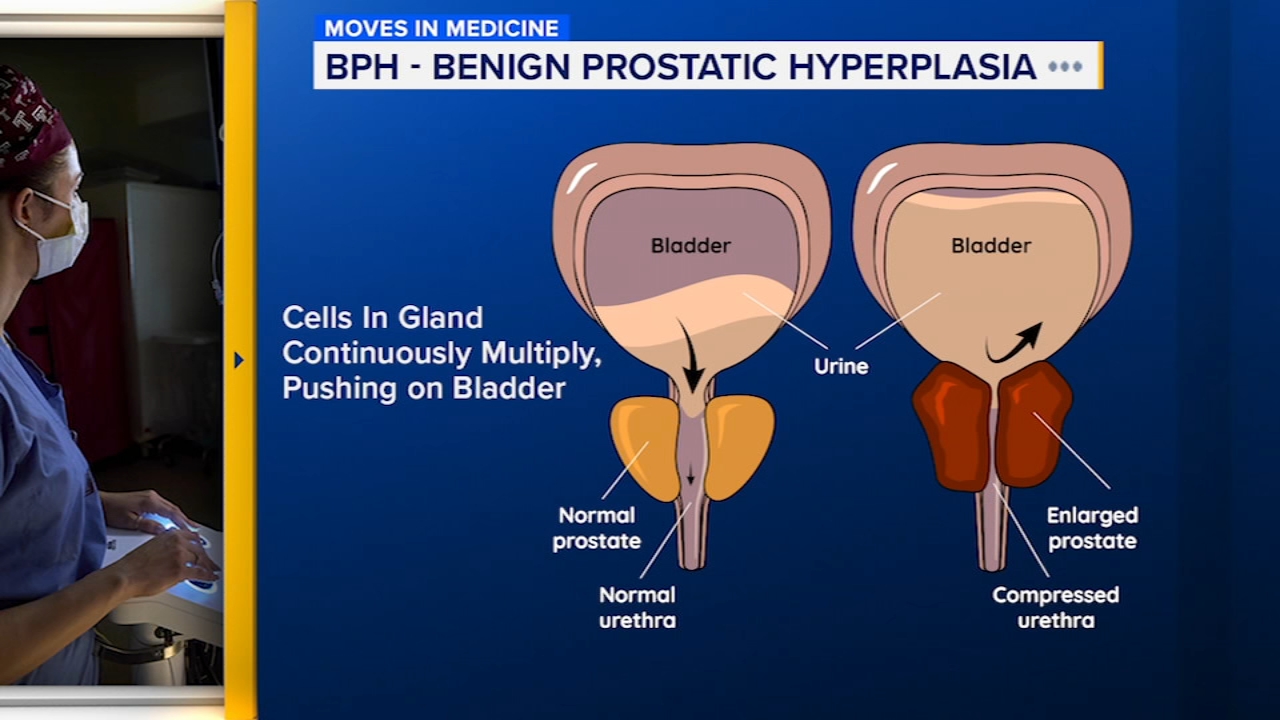
Cells in the prostate gland continuously multiply, and push on the bladder over time.
"It's pushing on the bladder. It's pushing on the urethra," he says, adding, "As the tube gets smaller, it's harder to push the urine through that."
BPH was dictating Shannon's life more and more.
"I was dehydrating myself intentionally, because, you know, anytime a glass of water goes in, it came out," he says.
Dr. Sterious says minimally-invasive procedures like Urolift and ReZum help at first, and don't have undesirable effects like incontinence or impotence, but the relief wears off.
And they may not be right for the size of a patient's prostate, which can range up to 100 grams.
"Urolift, you know, after five years, there's a good 35 to 40% you're gonna need something else. And then ReZum is something like 15% to 20%," he says.
Some other more invasive procedures can have unwanted side effects, such as incontinence or ejaculatory or erection problems.
For larger prostates, the Fox Chase-Temple Urologic Institute primarily offers the HoLep or Aquablation procedures.
After visiting Dr. Sterious, Kristian opted for Aquablation - an ultrasound-guided robotic procedure that uses high-pressure water to remove tissue from the prostate.
"I plan out where in the prostate the water jet goes, kind of resect that tissue," Dr. Sterious says.
Shannon says there was some discomfort right after the treatment, but five years later, it's as if he never had BPH.
And trips to Penn State are fun again.
"I can go into a game, enjoy three hours of football and not feel like I've got to, you know, disrupt the entire aisle," he says with a chuckle.
Although BPH is very common, Dr. Sterious says men shouldn't ignore it, because it can cause permanent bladder damage.
"I had to tell a 62 year old your bladder doesn't work and you're gonna need a catheter rest of your life," Dr. Sterious remembers.
"And he kind of broke down a little bit, like, what do you mean?" he adds.
"The urine can back up into the kidneys and you can get like infections and you get sepsis," Dr. Sterious warns. "Once your bladder stops functioning appropriately, like that's it. We can't put the nerves and the muscles back. We don't have the technology."