Team approach remedies two prostate issues together


ELKINS PARK, Pa. (WPVI) -- Because the human body is so complex, medical problems are seldomly stand-alone events. That's why a multi-disciplinary approach is important to getting a better quality of life.
"My father had prostate cancer, and that's what he actually died from," says Dave Donaldson of Elkins Park, Pennsylvania.
Because of this, Dave has always made prostate health a priority.
For a decade, he's been under active surveillance with regular blood tests and biopsies for a slow-growing cancer.
Last year, that changed.
"The biopsy came back showing that cancer had progressed," he says.
Dr. Alexander Kutikov, Donaldson's doctor at Fox Chase Cancer Center, referred him to Dr. Mark Hallman for radiation treatment.
Radiation used to be a lengthy process.
"That was daily treatments, Monday through Friday, five days a week, and it would be 39 to 40 treatments," Dr. Hallman says.
There's an alternative now.
"The more effective treatments are really short courses of radiation where we deliver high doses of radiation in a short period of time using very precise techniques," he says.
This regimen normally means fewer side effects.
However, Donaldson also had an enlarged prostate, one that often sent him in search of a restroom.
"I stopped going to Eagles games. I stopped going to Flyers games, stopped going to Phillies games," he says.
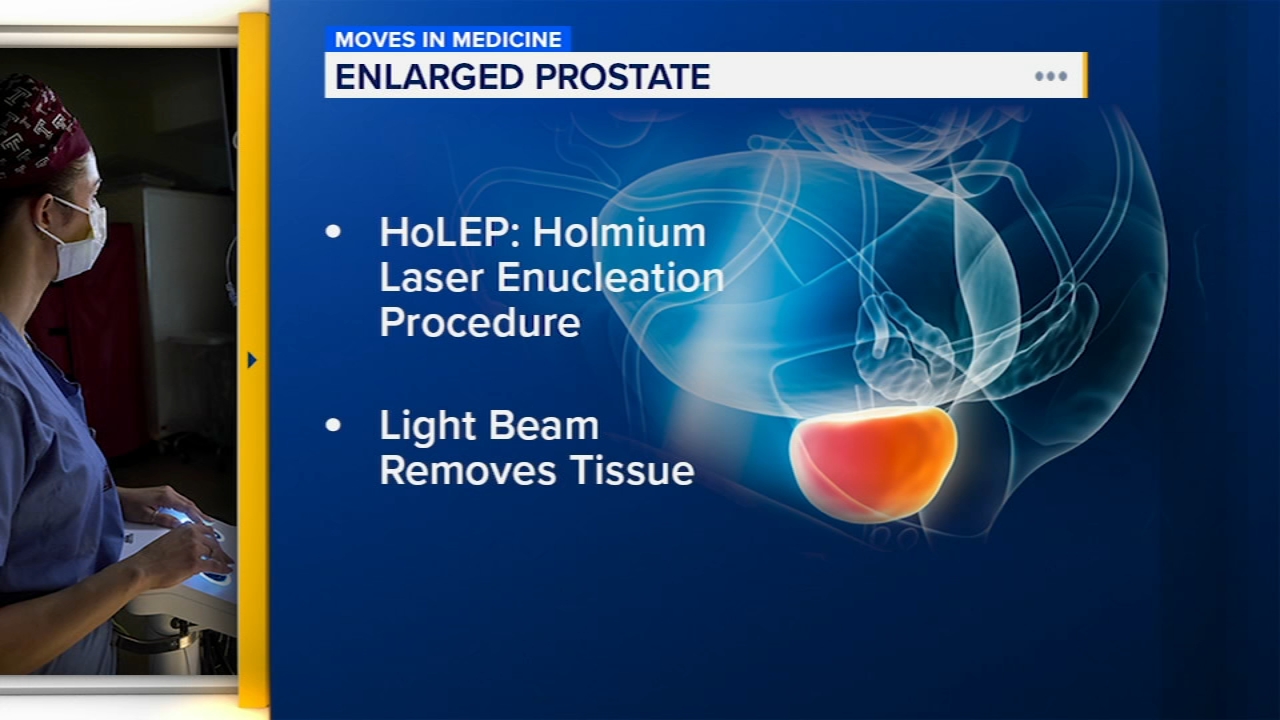
High-dose radiation could have made his problem even worse. But general urologists at Fox Chase had a fix: a laser e-nucleation procedure called HoLEP.
It's a minimally invasive process using a light beam to remove tissue inside the prostate, improving flow from the bladder. After recovering from that, Donaldson had the radiation.
"Five treatments that's over two weeks," says Dr. Hallman.
That short course destroyed the cancer, and with the HoLEP procedure, Donaldson has a much better quality of life.
"I'm not getting up in the middle of the night five or six times," he says.
Dr. Hallman says men considering radiation for prostate cancer should see both a urologist and a radiation oncologist to deal with any issues like this before treatment, as well as the after-treatment side effects of radiation.