Understanding and preventing 'Kidney Stone Season'


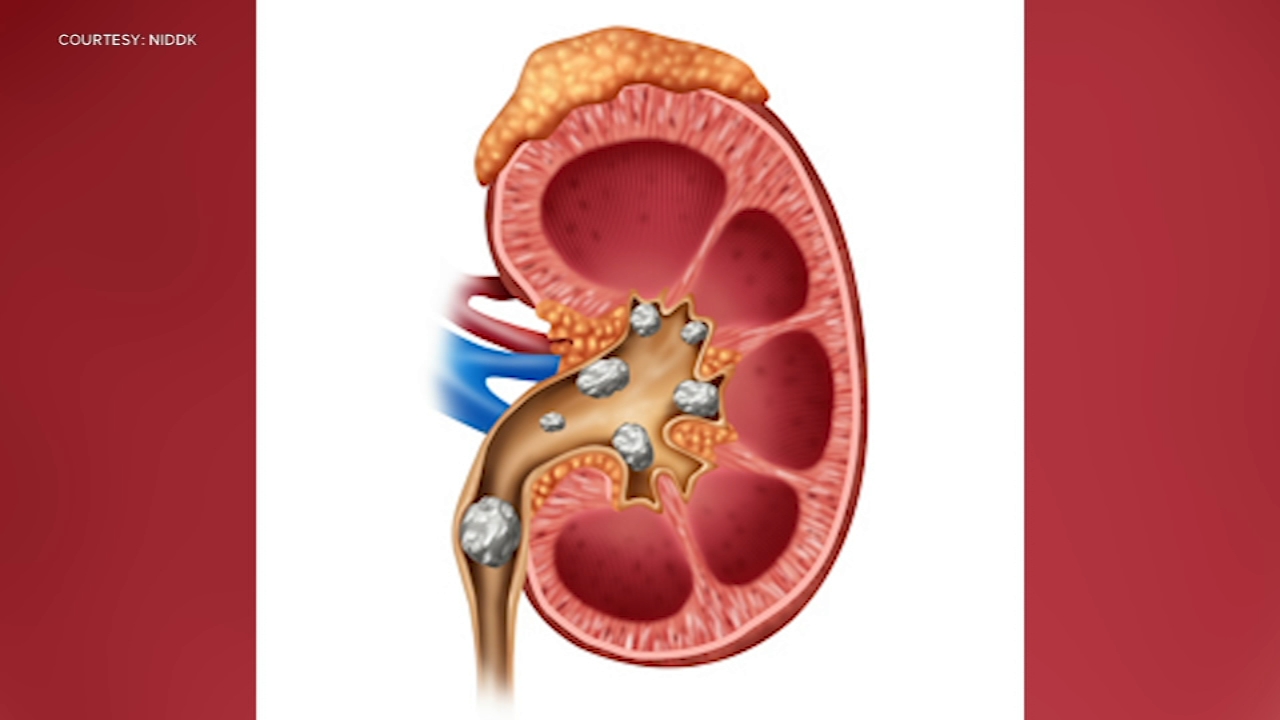
FLOURTOWN, Pennsylvania (WPVI) -- Summer is known as "kidney stone season," when more people get this painful problem.
"I felt pain in my kidneys. Didn't know what it was," says Peter Shaifer of Flourtown, Montgomery County.
But Peter wasn't really bothered by the discomfort until last December.
"The pain came that was severe enough to have me go to the hospital," he says.
Peter had an infection and stones in both kidneys: four centimeters in the left, and two nine or 10 millimeter ones in the right.
Temple Health endourologist Dr. Justin Friedlander says stones are becoming more common.
"At least one out of every 11 adults," he says.
They are even becoming less rare in 20-year-olds and adolescents. Heat, humidity, and lack of hydration are all factors in the summer increase.
But Dr. Friedlander says as America's climate warms, the so-called "Kidney Stone Belt" is moving out of the South and Southwest, turning it into a nationwide trend.
Too much salt and processed food are factors in that rise, too.
"We're seeing a rise in rates of kidney stones across ages, genders, societal demographic groups...everywhere," he says.
Dr. Friedlander says the treatment strategy depends on the size and location of the stone. Small ones or those close to the bladder are encouraged to pass on their own with medication.
There's also shockwave lithotripsy.
"Waves that are generated by a shockwave machine that get transmitted through the body to break the stone into smaller pieces," he says.
Retrieval is more invasive.
"We'll pass a camera through the urinary system to the stone and then use a laser to break the stone into smaller pieces that can be evacuated," he says.
Stones three-quarters of an inch or larger can be surgically removed through the back.
The largest of Peter's stones was removed that way, while the others were done by retrieval.
He's thrilled to have the stones, the infection, and an unrelated prostate issue resolved.
"I haven't felt as good as I do now in, I don't know, 10 years," he says.
Dr. Friedlander says that along with drinking more water, eating more fiber-rich foods - particularly fruit and vegetables - can lower chances for kidney stones.