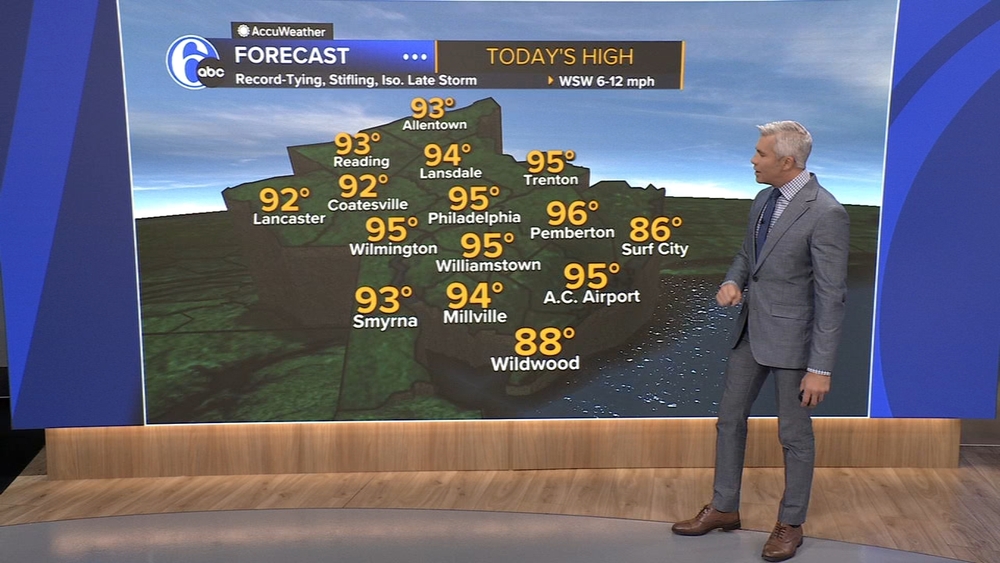
The World Cup is set to begin during one of the hottest times of year in North America, and several of the host cities may see high temperatures during the soccer tournament.
The competition will take place over a large geographic area on the North American continent -- in more than a dozen cities in Canada, the U.S. and Mexico -- some of which could see temperatures that may put athletes and even spectators at risk now that meteorological summer is underway, experts told ABC News.
Average temperatures in many of the World Cup cities could exceed the 80s and 90s, National Weather Service records show. Southern U.S. cities like Dallas, Houston, Atlanta and Miami also face persistent humid conditions which can bring an elevated heat index and make it more difficult for the body to regulate its temperature.
A 2024 study found that extreme heat could pose a significant threat to players and spectators at several of the host cities during the hottest part of the day.
Nearly all of the 2026 World Cup host stadiums now see more extremely hot days during June and July than during the first North American World Cup in 1970, according to research nonprofit Climate Central. The frequency of extremely hot days in June and July has tripled, on average, across 10 repeat host cities since Mexico hosted in 1986 and the U.S. hosted in 1994.
The sites with the highest risk were found to be in Monterrey, Mexico; Arlington, Texas; and Houston -- which had suggested average hourly UTCI values above 49.5 degrees Celsius, or 121.1 degrees Fahrenheit, the researchers found.
Several of the stadiums in those cities have air conditioning. AT&T Stadium in Arlington and NRG Stadium in Houston are all air-conditioned. Hard Rock Stadium in Miami is partly covered with canopy and not completely enclosed or air-conditioned, while Estadio Monterrey in Mexico is an open-air stadium and does not feature a closed, air-conditioned seating bowl for spectators.
"It's not going to be a problem when people have access to air conditioning," Craig Crandall, professor of internal medicine at the University of Texas Southwestern Medical Center, told ABC News. "There is really no worries or concerns with respect to people overheating."
However, most of the training facilities are not air conditioned, according to Doug Casa, CEO of the University of Connecticut's Korey Stringer Institute, a research facility created following the Minnesota Vikings offensive lineman's 2001 death from exertional heat stroke.
Heat and humidity could impact athletes' performance
Heat can severely impair athletic performance by causing cardiovascular strain, hyperthermia and dehydration, according to the Gatorade Sports Science Institute.
"We know that as individuals get hot, their ability to perform both at a competitive level, as well as just is daily activities, is compromised," Crandall said.
Hyperthermia and dehydration can cause players to cover less distance on the field, decreased speed for max sprints and decreased cognitive performance, according to Casa. Recovery for the next game could become an issue as well.
"It takes your body a long time to recover from these efforts," he said.
Players will still need to adapt quickly to local climate conditions, which can be a challenge, Kate Lindner-Cendrowska, a researcher at the Institute of Geography and Spatial Organization at the Polish Academy of Sciences and an author of the 2024 study, told ABC News.
Efforts to help athletes acclimatize to hot weather could help preserve peak performance, the experts said. Trainers will utilize sports science to prepare the athletes for a performance advantage in hot conditions, according to Casa.
An athlete from a colder climate who will be based in a warmer climate should give themselves 10 to 14 days of exposure to the heat to get used to the weather, Crandall said. After that period, they will experience less cardiovascular stress, better sweating response and, overall, will be less likely to develop heat injury.
Players from the southern hemisphere are coming from late fall conditions, while others from the northern hemisphere have not yet experienced true summer temperatures, Casa noted.
"There's almost nobody like really heat acclimatized or heat ready for this," he said.
Spectators are also at risk from heat
For spectators, arriving to and leaving the matches poses the most risk -- especially if they will be drinking alcohol, which could dehydrate them faster, the experts said.
If a group of fans were to tailgate before a game in Texas or Mexico, they could be particularly susceptible to heat-related injury, Crandall noted.
Extreme heat is the number one weather-related killer, according to the Centers for Disease Control and Prevention. Vulnerable populations, such as children, the elderly and those with preexisting conditions, are most at risk.
With sufficient time to adapt, access to shade and adequate water, healthy people can tolerate extended exposure to environmental heat stress, according to the Gatorade Sports Science Institute.
Fitness is "the great protector" in the heat, but many of the fans will not be in optimal physical shape, Casa said.
"They're no where near as physically active as the athletes," Crandall said.
Hydration will be critical to fans' safety, the experts noted.
A recent change to FIFA's policy banned World Cup spectators from bringing refillable water bottles into the stadiums. Previous rules on FIFA's Stadium Code of Conduct stated that fans could bring transparent, reusable bottles up to 1 liter, ESPN reported on Thursday.
"For the avoidance of doubt, reusable water bottles may not be brought into the stadium," the document now states.
Criticisms of FIFA's current policies
For the 2026 games, FIFA has implemented three-minute hydration breaks to take place during halftime of each of the games.
The breaks are part of "a focused attempt to ensure the best possible conditions for players," FIFA said.
But those efforts are not sufficient, and three minutes is "woefully too short," according to Casa.
"It's just not enough to be meaningful," he said.
Several current and former professional players wrote an open letter to FIFA to share concerns about heat impacts.
"Many of us have experienced heat impacting our sport. It can make you feel light-headed, dizzy, experience fatigue, muscle cramps and worse," the players wrote. "You can run less and it becomes impossible to play with the same intensity as with more average temperatures."
The open letter implored FIFA officials to protect players at all levels from heat impacts and demanded that FIFA update its heat-stress framework before the start of the tournament.
The players also called on FIFA to drop fossil fuel sponsors and reduce its climate impact, partly by implementing a "small, more regional" calendar to reduce climate impacts.
"It would be a missed opportunity if a sport so impacted by the climate crisis doesn't take its responsibility in addressing it," the players wrote.
FIFA said in December 2025 that the finalized schedule for the 2026 Men's World Cup has been designed to minimize travel for teams and fans, and maximize rest days between matches for all participating nations.
Several matches taking place in Miami will occur at 5 p.m. and 6 p.m. ET -- a "big mistake" due to the radiant effect of the sun at that time of day, according to Casa.
"It's going to have a massive impact on performance, health and safety for the players, for the spectators, for the workers," he said.
FIFA did not immediately respond to ABC News' request for comment.
ABC News' Dan Peck contributed to this report.