Phillies' Bryce Harper concerned over MLB lockout ramifications

LOS ANGELES -- Fear of a tense, prolonged fight over Major League Baseball's new collective bargaining agreement were only exacerbated when owners and players unveiled their initial proposals earlier this week.
The MLB Players' Association sought advances to the current economic system, including increases to the minimum salary, higher luxury-tax thresholds and an expansion of the pre-arbitration bonus program unveiled during the last labor fight. The league, representing its 30 owners, pitched something entirely different: a strict cap-and-floor system, similar to that of the NHL, and a 50/50 revenue split with players.
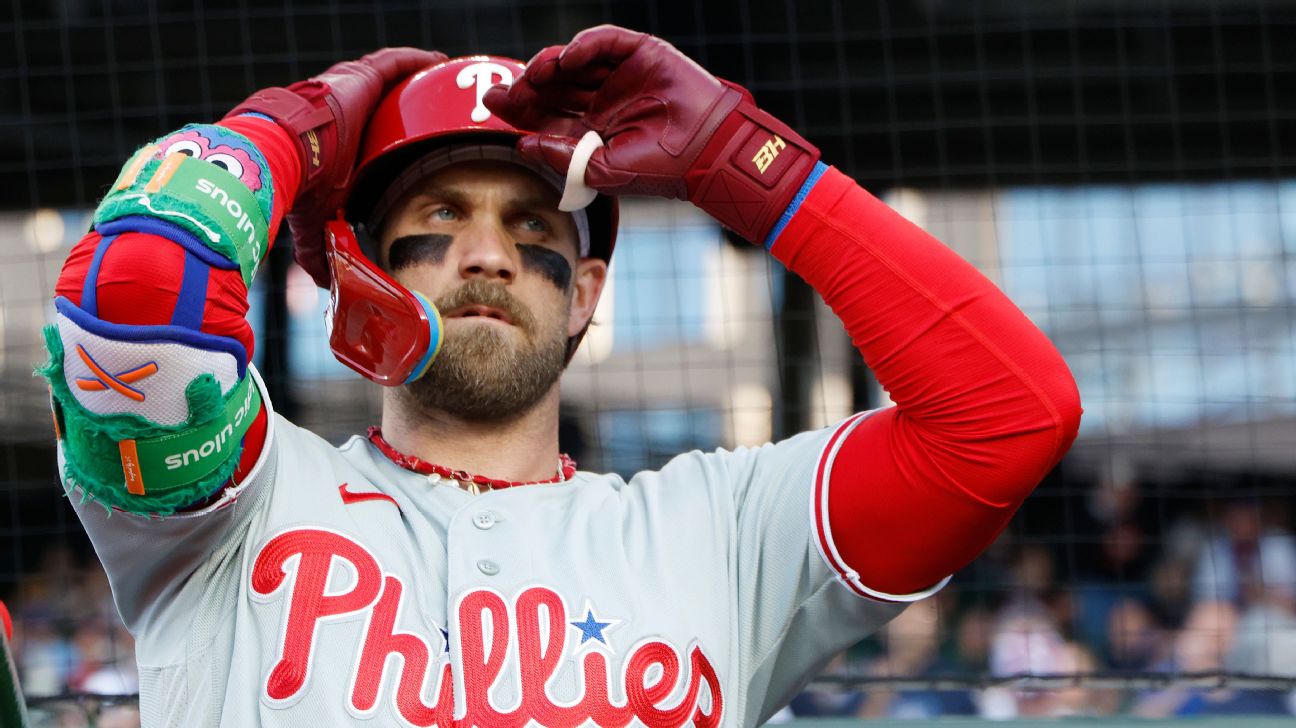
Philadelphia Phillies first baseman Bryce Harper, a two-time MVP and one of the most influential voices on the players' side, said he wasn't surprised by the league's salary cap pitch but expressed concern over what could happen to the sport if the 2027 season is compromised because of it.
"We're coming from two different areas, but we both have to understand our game is in a great position right now to succeed, and we can't lose that momentum," Harper told ESPN from Dodger Stadium on Sunday morning. "We can't lose that momentum as players. We can't lose that momentum as owners. So wherever we're at -- whatever they're coming with, whatever we're coming with -- you have to come to an agreement before any of that happens because there's other things to do. It's not like '94, where there was nothing else to do. It's not just, 'Oh, baseball's here.' No, there's a lot of other things to do than just watch baseball."
The last time MLB pushed for a salary cap, it led to the cancellation of the 1994 World Series, a point raised by MLBPA interim executive director Bruce Meyer in his response to the league's proposal on Thursday. It wasn't until later that decade, when Mark McGwire and Sammy Sosa engaged in a thrilling home-run chase, that MLB recovered its popularity.
Harper and several other players are fearful that a prolonged labor fight in a time of social media and unprecedented viewing options would severely hamper the gains MLB has made in recent years with regard to attendance, ratings, international appeal and, as a result, revenue.
Harper said one of the biggest reasons for those gains is the type of team a cap would hinder: the Los Angeles Dodgers, the two-time defending champions who hold a projected competitive-balance-tax payroll north of $400 million.
"Our game is in a great direction, in a great place, because of the Los Angeles Dodgers," Harper said. "Obviously they make a lot of money, they're able to get free agents, but the Dodgers don't just do that. They draft well. They do a very good job in the minors, developing guys. Other teams can't do that. You can spend all the money in the world, but you can have a terrible farm system and not have teams come up."
This season has provided an ideal representation of Harper's point. Three teams with top-10 payrolls -- the Boston Red Sox, New York Mets and Houston Astros -- are so far out of contention that they will probably deal established players at the trade deadline, while three teams with bottom-10 payrolls -- the Cleveland Guardians, Tampa Bay Rays and Milwaukee Brewers -- sit in first place.
Players and agents widely believe the league's push for a cap is motivated almost entirely by the goal of maximizing franchise values, but MLB commissioner Rob Manfred has framed it as a desire to appease mid- to small-market fans who crave a more level playing field. While announcing its proposal -- with an initial cap of $245.3 million and a floor of $171.2 million -- the league sent out a fact sheet that noted, among other things, that a small-market team has not won the World Series since 2015.
Harper confronted Manfred in Philadelphia last July, telling him to "get the f--- out of our clubhouse" if he wanted to talk up the benefits of a salary cap. Given that, Harper said he wasn't surprised by the league's push. Neither was back-to-back American League Cy Young Award winner Tarik Skubal, who's part of the MLBPA's executive subcommittee.
"I don't think it impacts what they think it impacts in terms of having an even playing field," Skubal told ESPN's Jesse Rogers on Friday. "I don't think that a salary cap does that by any means, so it didn't matter that the floor may have been higher than people thought, even though the ceiling is still kind of low. It doesn't matter what the numbers are, so to speak."
Under MLB's economic proposal, which left a phase-in timeline up for negotiation, 12 teams would currently have to increase payroll by a combined $617 million and eight teams would have to decrease it by a combined $578 million to satisfy a new cap and floor. But there is also an escrow system, whereby a variable percentage of a player's income is set aside in case the league does not meet its projected revenues.
If the league makes more than projected, players essentially get more. But if they don't, players have to surrender some of their earnings in order to guarantee the 50/50 split -- which happened in the NBA, where players gave up nearly $500 million last year. Harper, like so many of his peers, says he is wary of that system and is hopeful players stay united on their long-held stance against a cap. One thing he believes might help is all the young players recently signing early extensions, most notably Konnor Griffin, Kevin McGonigle, Roman Anthony and Pete Crow-Armstrong.
"It's helping us because they're already locked in," Harper said. "So they can be like, 'Whatever's best for everybody, I'm gonna do.'"
During the last round of labor talks, owners imposed a lockout on the eve of the CBA's expiration on Dec. 2, 2021, freezing transactions and any communication between teams and players. It wasn't until 99 days later when a new CBA was ratified. Another lockout in six months is almost certain. How long it lasts remains to be seen.
"It's just the first proposal," Harper said. "I don't want to miss games. I don't think anybody wants to miss games. I'm getting later in my career, I don't want to miss games. I would love to get this done, on a personal level, just because I don't want to do that, but we'll see."br/]