What's inside Pennsylvania's $50B budget signed by Gov. Shapiro

HARRISBURG, Pa. -- Billions of dollars for Pennsylvania's public schools and social services could soon start flowing after four-plus months of delay, as lawmakers on Wednesday approved key elements of a roughly $50 billion spending plan to break the state's budget impasse.
A concession to help seal the deal meant Democrats agreed to Republican demands to undo a regulation aimed at making Pennsylvania the only major fossil fuel-producing state to force power plant owners to pay for their planet-warming greenhouse gas emissions.
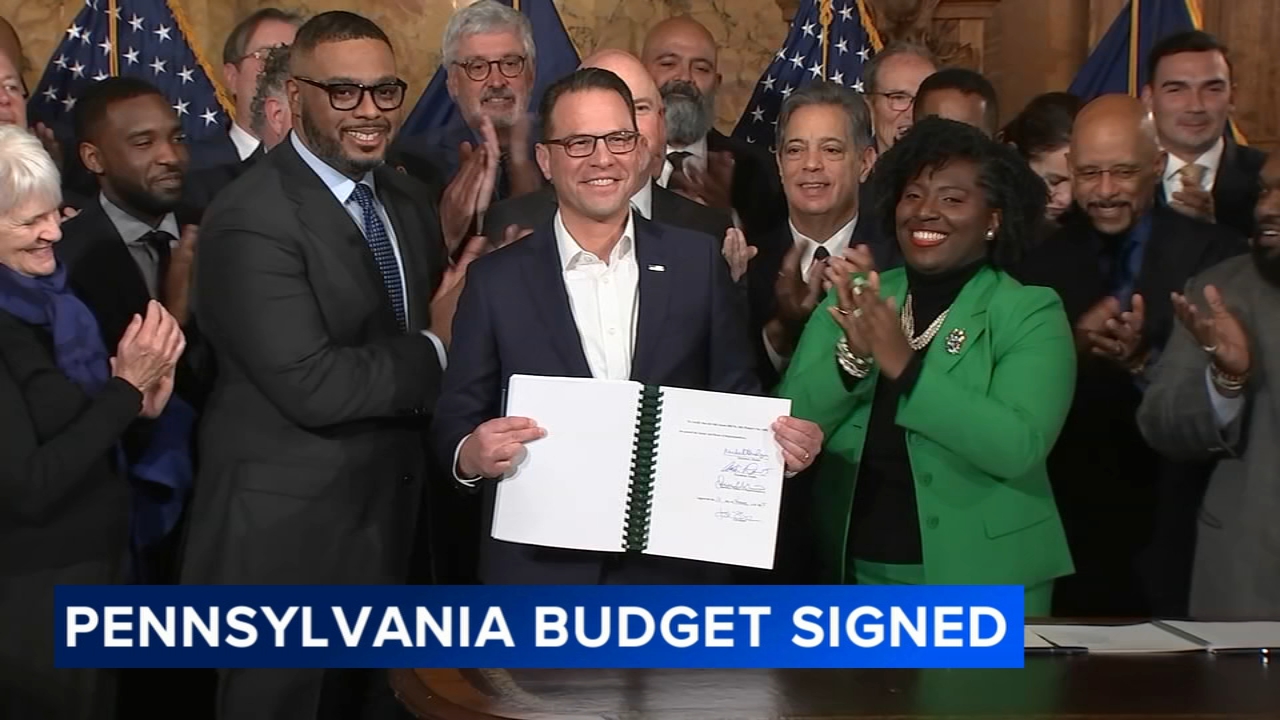
Democratic Gov. Josh Shapiro signed several key budget bills shortly after they passed, approving hundreds of pages of budget legislation that had barely been public for a few hours after weeks of closed-door negotiations.
In a Capitol news conference, Shapiro called it a "great budget" that came from negotiations with a politically divided Legislature where "we stayed at the table and we all stood up for the things that mattered most."
Budget Breakdown
- INVESTING IN EDUCATION: Shapiro says the budget provides an overall increase in education funding totaling more than $900 million, including a $565 million increase in public school adequacy funding, $105 million for Basic Education Funding, and a $40 million increase for Special Education Funding. It also includes a $125 million investment in school infrastructure, a Pre-K rate increase for teachers, and $175 million in savings to public schools through historic cyber charter reform.
- CUTTING TAXES FOR WORKING FAMILIES: It includes an earned income tax credit for working families that will deliver $193 million in tax relief equal to 10 percent of the federal credit.
- STRENGTHENING THE WORKFORCE: The budget funds a $25 million child care recruitment and retention initiative and raises wages for direct care workers with a $21 million investment in their work.
- SUPPORTING SENIORS AND VULNERABLE POPULATIONS: The budget strengthens community-based care by providing a $10 million increase for older Pennsylvanians through local Area Agencies on Aging and an $11 million boost for food assistance programs.
Under the $50.1 billion no-new-taxes budget deal, new authorized spending would rise by about $2.4 billion, or 5%, including some cash going onto last year's books.
Republicans said scrapping the power plant emission rule was a major policy victory for the energy economy in the nation's No. 2 natural gas-producing state.
Democrats won't get the amount of money that Shapiro originally sought in his initial budget proposal, but the deal delivers substantial new sums to public schools, as Democrats had sought, and an earned income tax credit for lower earners.
It will also bring relief that the stalemate is over. Senate Majority Leader Joe Pittman, R-Indiana, called it an "imperfect product" that reflected the difficult compromises of a politically divided government.
"While it may have taken time, more time than any of us would have preferred, we have brought a divided government together and proved that it is not dysfunctional government," Pittman said during remarks on the Senate floor.
The state lost some of its spending authority on July 1 without a signed state budget in force, forcing vendors to go without payment, unable to pay workers. Without state aid, counties, school districts and social service agencies warned of mounting layoffs, borrowing costs and growing damage to the state's safety net.
The agreement to back off the carbon dioxide cap-and-trade regulation on power plants comes six years after then-Gov. Tom Wolf made joining the Regional Greenhouse Gas Initiative the centerpiece of his plan to fight climate change.
Ending it is "one of biggest policy wins in the past 10 years," Sen. Wayne Langerholc, R-Cambria, said.
Wolf's regulatory plan had sidestepped resistant Republican lawmakers in a bid to make Pennsylvania - the nation's second-largest natural gas producer - the only major fossil fuel-producing state to undertake a carbon cap-and-trade program.
It had yet to take effect while the state's highest court considers a legal challenge that questions whether the carbon-pricing plan amounts to a tax, and is thus unconstitutional without legislative approval.
Backers of the regulation included environmental advocates as well as solar, wind and nuclear power producers who had called it the biggest step ever taken in Pennsylvania to fight climate change.
It was opposed by Republicans, fossil fuel interests and the labor unions that work on pipelines, refineries and power plants who warned that the cost was sending energy companies to other states to build new gas-fired power plants.
Shapiro had also expressed misgivings about it, and an alternative plan that he proposed has yet to receive traction in the Legislature amid Republican opposition.
Almost all of the overall spending increase will go toward Medicaid and public schools.
Meanwhile, the budget didn't deliver what Shapiro had sought in higher public transit aid, what counties had sought for mental health services or what providers such as nursing homes, insurers and home-care providers had sought in Medicaid reimbursements.
The budget plan holds the line on tax rates and fees, lawmakers say. But it uses more than $4 billion in surplus cash to achieve balance, the second straight year that Pennsylvania is running a multibillion-dollar budget deficit, reflecting a slow-growing economy and a shrinking workforce that delivers relatively meager gains in tax collections.
The agreement also includes Pennsylvania's first refundable earned income tax credit, which reduces or wipes out the state income tax for people who make less than a certain amount of money, depending on how many children they have. It's something most other states have on their books.
Pennsylvania's plan is projected to cost nearly $200 million a year. Had it been in effect this year, the average eligible family would have gotten a $650 break, lawmakers say.
The Associated Press contributed to this report.