Looking at the Heisman and CFP markets after Week 1: Favorites, fades and best bets

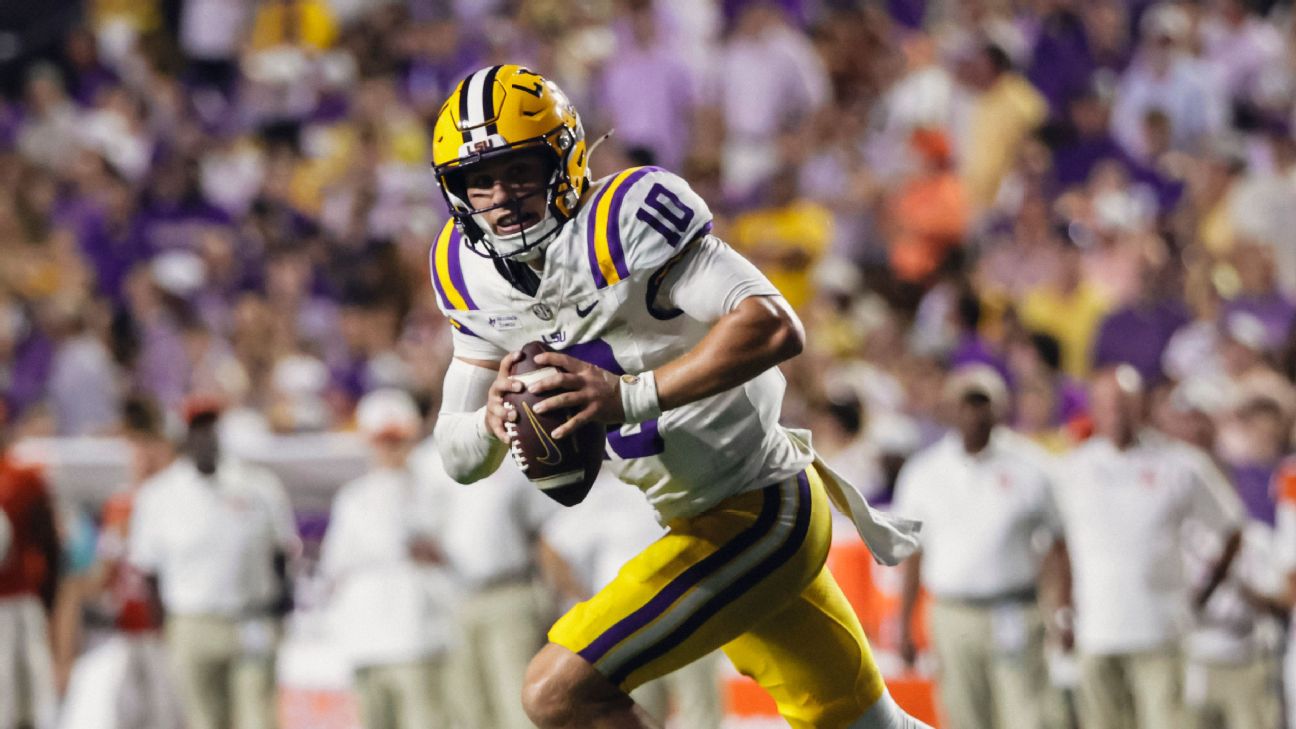
Week 1 of the college football season gave us points galore. Of the 21 matchups featuring the top 25 teams since Friday's kickoff, 15 teams scored 40-plus points. Records were broken, quarterbacks entered the Heisman conversation and contenders looked every bit like real contenders.
But when almost every team dominates, the final score is in no way the final differentiator. Let's separate what's real from what's noise.
First, let's define what that means: I'm asking whether the production came from something repeatable enough to translate against tougher competition.
Did the quarterback make throws that will still be there against a better defense? Did the offensive line create consistent advantages? Did the defense control the game without relying on turnovers? And -- most importantly for futures bettors -- did we learn enough to justify the current odds? Here's a look at both the national championship and Heisman Trophy races after Week 1.

LSU gave us the strongest evidence by producing the most dominant performance, but context matters. I was skeptical of Clemson during preseason, so I can't treat Clemson like a proven opponent simply because it makes LSU's win look better. Still, outgaining a Power Four opponent 644-145 without winning the turnover battle is difficult to dismiss.
The concerns are the offensive line and conventional passing game, which both had flaws that were masked by QB Sam Leavitt's 113 rushing yards (which helped when the offensive structure broke down). LSU's defense and Leavitt's mobility are real, showing that the Tigers have multiple methods to win games. At 14-1, that performance carries more weight than most Week 1 blowouts. Let's call it a measured upgrade.

Miami's passing game also looked real. QB Darian Mensah threw for 401 yards and five touchdowns, while WR Malachi Toney broke Miami's 42-year-old single-game receiving record with 234 yards in less than three quarters. Mensah was accurate when throwing downfield, against pressure and when Stanford blitzed. The concern is concentration: Toney accounted for most of the explosive production, while Miami averaged only 3.8 yards per carry. The Hurricanes' national title case at 9-1 isn't there yet.

Ohio State produced 671 yards with 434 through the air and a monster 237 on the ground. WR Jeremiah Smith remains the kind of receiver who changes how defenses have to play, and QB Julian Sayin showed he can distribute the ball accurately at every level. At +550, Ohio State was already priced as the favorite. Week 1 confirmed what we already knew without creating additional betting value.

Penn State had its first shutout in a head-coaching debut since 1915. QB Rocco Becht's intermediate passing and his connection with Koby Howard was elite. However, the Nittany Lions averaged only 3.6 yards per carry against Marshall. At 50-1, there may be upside if the run game, weak run blocking and ordinary pass rush all improve. As of right now, those prevent this result from being a "complete team" statement. The Nittany Lions don't yet belong in the championship conversation.

The Heisman market is even more vulnerable to Week 1 noise because outrageous numbers immediately become national narratives. Miami's Mensah is now the favorite after throwing five touchdowns, followed by Arch Manning (+950), Jeremiah Smith (+1000) and Toney (+1250). The performances matter, but the question is whether the prices are now asking us to treat one Saturday like an entire resume.
Darian Mensah's underlying performance was excellent: he completed all six intermediate throws, produced three touchdowns on six deep attempts and went 8-for-8 when Stanford blitzed. That's more meaningful than throwing five touchdowns against an overmatched opponent. Still, +550 is an aggressive price after one game, especially when Toney accounted for 234 receiving yards. Miami has two candidates whose cases are built largely on the same production. If Toney continues generating the highlights, he could complicate Mensah's ability to own the narrative.
Two things can be true: Malachi Toney deserves to be included and that +1250 price is a difficult buy. Only two (and a half) receivers have won the Heisman since 1991: Desmond Howard in 1991 with Michigan, Alabama's DeVonta Smith in 2020 and Colorado's two-way unicorn CB/WR Travis Hunter in 2024. Generally, a receiver needs the absence of an obvious quarterback winner. Currently, he's competing with Mensah for credit within his own offense.
Jeremiah Smith (+1000) is one of the strongest non-quarterback candidates because his ability was never in question. However, if Sayin stays efficient while the Buckeyes keep winning, Smith must produce enough individually to prevent his own quarterback from absorbing the credit.
Texas had an encouraging performance from Arch Manning (+950), especially on deep throws, where he finished 3-for-3 for 110 yards. The catch: he faced pressure on only four dropbacks. The biggest preseason question was whether Manning could remain efficient when protection broke down, and Texas State couldn't test that. This was confirmation of his talent, not at all proof that the pressure and short throw problems have disappeared.
The most interesting price remains Ole Miss QBTrinidad Chambliss at +1300. He had nearly 400 total yards and four touchdowns against ranked Louisville, including 190 yards and three scores on deep throws. Unlike other options, he already had production against a ranked opponent and still has plenty of opportunities ahead to create signature moments. The two turnovers matter, but his explosive passing and mobility were exactly what supported his preseason case.
Biggest mover: LSU's Sam Leavitt dropped from +2200 to +1500 after 113 rushing yards and two touchdowns. His passing performance was not strong enough to justify that price change. He was inconsistent as a passer, especially when pressured. His running ability keeps him in the early conversation for now -- until I see him beat better teams with his arms before buying in.

This was my preseason pick and, after Week 1, it hasn't changed. Out of everything on the futures board, it's the best combination of price, repeatable Week 1 performance and future opportunity. Aside from his production against Louisville while other contenders saw price movement, Chambliss' didn't budge from the preseason market, yet he gave us more transferable evidence without the market charging more for it. His turnovers are likely the reason.
Ole Miss must still win enough games to keep him viable. Fortunately, the schedule gives him exactly what a Heisman candidate needs: home games against LSU and Georgia, with road trips to Texas and Oklahoma. Chambliss is the one prediction where the performance confirmed the preseason read and the price failed to adjust.